

Sustainable packaging is no longer a branding choice — it has become a legal, environmental, and commercial requirement.
Across Europe and the United States, regulations, retailer policies, and consumer expectations are rapidly reshaping how packaging must be designed, sourced, and verified. Companies selling internationally are increasingly responsible for the environmental impact of their packaging throughout its lifecycle.
For buyers and brand owners, understanding these requirements is no longer optional. Non-compliant packaging can lead to shipment delays, marketplace penalties, or restricted access to key markets.
In here, we show you the key packaging compliance requirements for brands selling in the US and EU, including regulations, restricted substances, recyclability expectations, compostability standards, and the certifications buyers now expect suppliers to provide.
Why Packaging Compliance Is Now a Business Imperative
Over the last decade, governments have transferred the responsibility of packaging from municipalities to producers through Extended Producer Responsibility (EPR) programs.
Under EPR, companies are obliged to take responsibility for the collection, recycling, and environmental impact of the packaging they put on the market.
EU policy: https://environment.ec.europa.eu/topics/waste-and-recycling/packaging-waste_en
The EU now has the following goals:
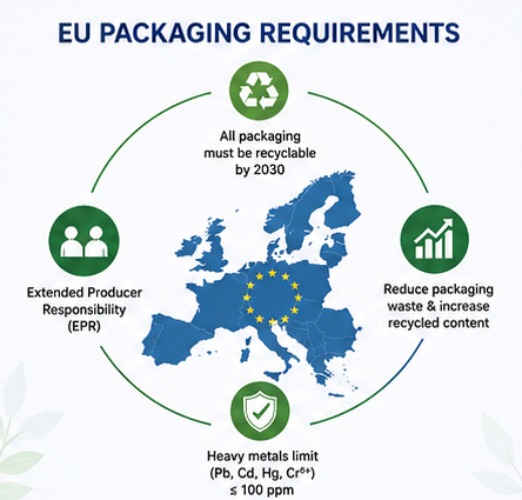
By 2030, all packaging must be recyclable
Packaging waste must be stopped from growing
Increased use of recycled material
Packaging compliance is now a passport to market access. The affected industries include:
E-commerce merchants
Brands at retail
Importers and Distributors
Private label makers
EU Packaging Regulations Buyers Should Know
The most relevant framework is the EU Packaging and Packaging Waste Directive (94/62/EC) and the forthcoming Packaging and Packaging Waste Regulation (PPWR).
Official description: https://ec.europa.eu/environment/waste/packaging_en
Packaging Heavy Metal Restrictions
The total content of heavy metals in packaging materials is restricted by law in the EU.
The total of the following must be less than 100 ppm:
Lead (Pb), Cadmium (Cd), Mercury (Hg), Chromium (Hexavalent) (Cr⁶⁺)
This also applies to:
Plastic packaging
Packing Paper
Printing inks & coatings
Test reports for heavy metals are now standard for entering the EU market.
2030 Recyclability Goal
The EU has set a target that all packaging sold in the EU should be recyclable by 2030.
This requirement is forcing brands to
Mono-material packaging
Paper-based packaging, Recyclable plastics like PE
More recycled content (RP)
For buyers, a key supplier question has turned into:
Is this packaging compatible with the EU recycling system?
Extended Producer Responsibility (EPR)
Most countries in the EU now require companies to register with national EPR systems before they can sell products. This applies to brands such as the following:
Amazon SellersAmazon Sellers
Cross-border eCommerce brand
Importers, Distributors
In many EU markets, data reporting on packaging is now mandatory.
Restricted Substances in Packaging Material
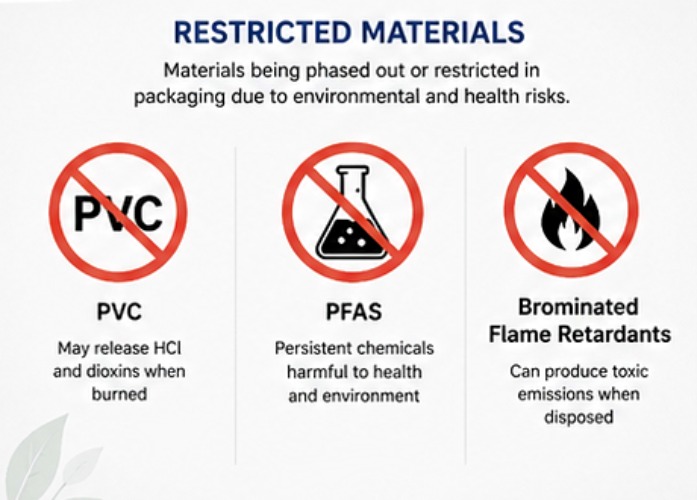
Modern packaging compliance is more than just being recyclable. Materials shall not contain substances that cause dangerous emissions or environmental hazards.
Polyvinyl chloride (PVC)
The use of PVC packaging is increasingly being limited due to the harmful emissions produced when it is disposed of or incinerated.
PVC, when burned, can release:
Hydrogen chloride (HCl)
Dioxins (stubborn toxic pollutants)
Many retailers and brands are moving to phase out PVC packaging.
Per- and Polyfluoroalkyl Substances (PFAS)
PFAS are being rapidly restricted globally, particularly in food and retail packaging.
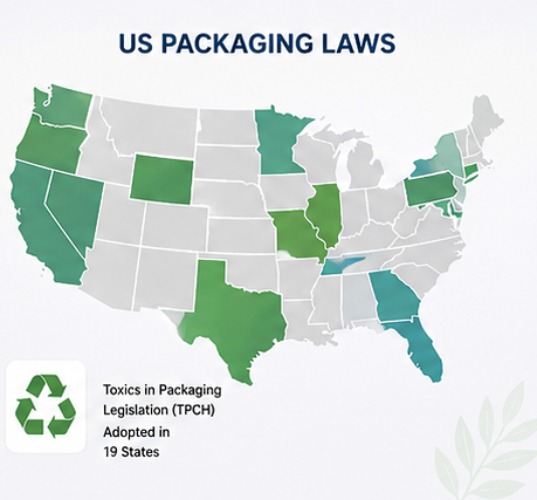
Due to persistence and health concerns, several US states and EU proposals now limit or ban PFAS in packaging.
Brominated Flame Retardants (BFRs)
These additives can emit toxic emissions during disposal and are increasingly restricted in consumer packaging applications.
Why Recyclability Is Now a Basic Requirement
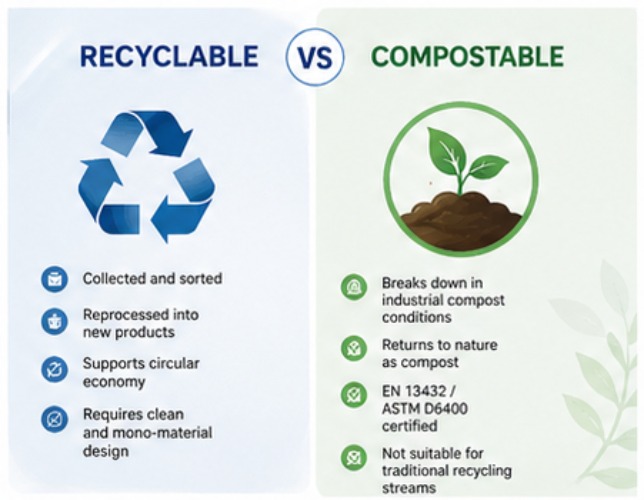
Recyclability is no longer a marketing gimmick—it is turning into a legal requirement.
Buyers now want packaging:
monomaterial
Widely recyclable
Compatible with existing recycling infrastructure.
This has spurred demand for:
Recyclable polyethylene films
Paper packaging
Post-Consumer Recycled Content (PCR Plastics)
Requirements for Compostable Packaging
Compostable packaging needs to be subjected to stringent industrial tests.
European Norm: EN 13432
This standard requires that:
90% Disintegration in 180 Days
Zero Toxic Residue
No negative effects on compost quality
US Standard: ASTM D6400
US equivalent standard for industrial composting.
Both standards ensure that materials:
Completely decomposes in industrial composting conditions
Don’t leave any microplastic traces
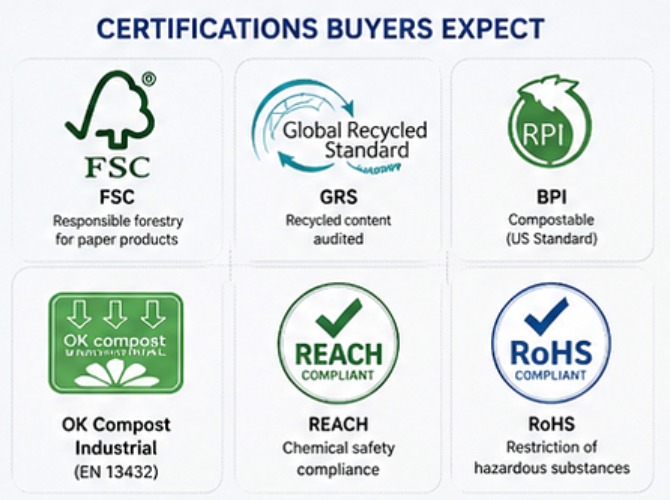
Packaging Suppliers: What Certifications Buyers Expect
Certifications are vital to the choice of suppliers.
Recycling and Sustainability
Certifications frequently requested:
FSC—ensures paper materials are responsibly sourced from forests
GRS / RCS — checks recycled material content
Compostability Certifications
Some of the commonly recognized compostability labels are:
OK Compost Industrial OK Compost Household BPI Certification
Chemical Safety and Compliance:
Commonly requested compliance documents:
REACH conformity
RoHS Compliant
Heavy Metal Testing Reports
These documents help brands show their regulatory and ESG compliance.
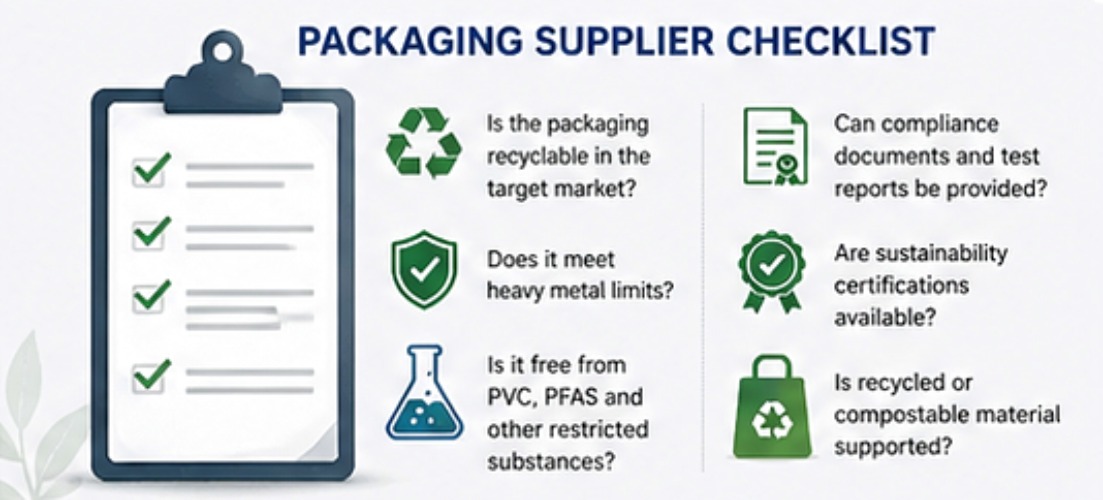
Supplier Evaluation Checklist
When you are checking before selecting a packaging supplier:
Is the packaging recyclable in the destination market?
Is it within heavy metal limits?
Does it contain no PFAS or PVC?
Can you provide compliance documentation?
Are there certifications for sustainability?
Would you like it in recycled or compostable material?
This has become the de facto checklist for today's packaging procurement.
Packaging compliance is changing fast in the US and EU. Brands can no longer afford to be reactive in their preparations; it is instead a competitive advantage.
Companies that act proactively and align with regulatory expectations, recycling infrastructure, and sustainability standards will be better positioned to meet future market demands.